Organising a 25-Year Multi-Speciality Hospital’s Digital Presence Around How Patients Actually Search for Care

Client: Pragathi Speciality Hospital

Pragathi speciality hospital title image

Services Provided

Website Design
Patient Experience Optimisation

Industry

Healthcare

Client

Pragathi Speciality Hospital

Challenge

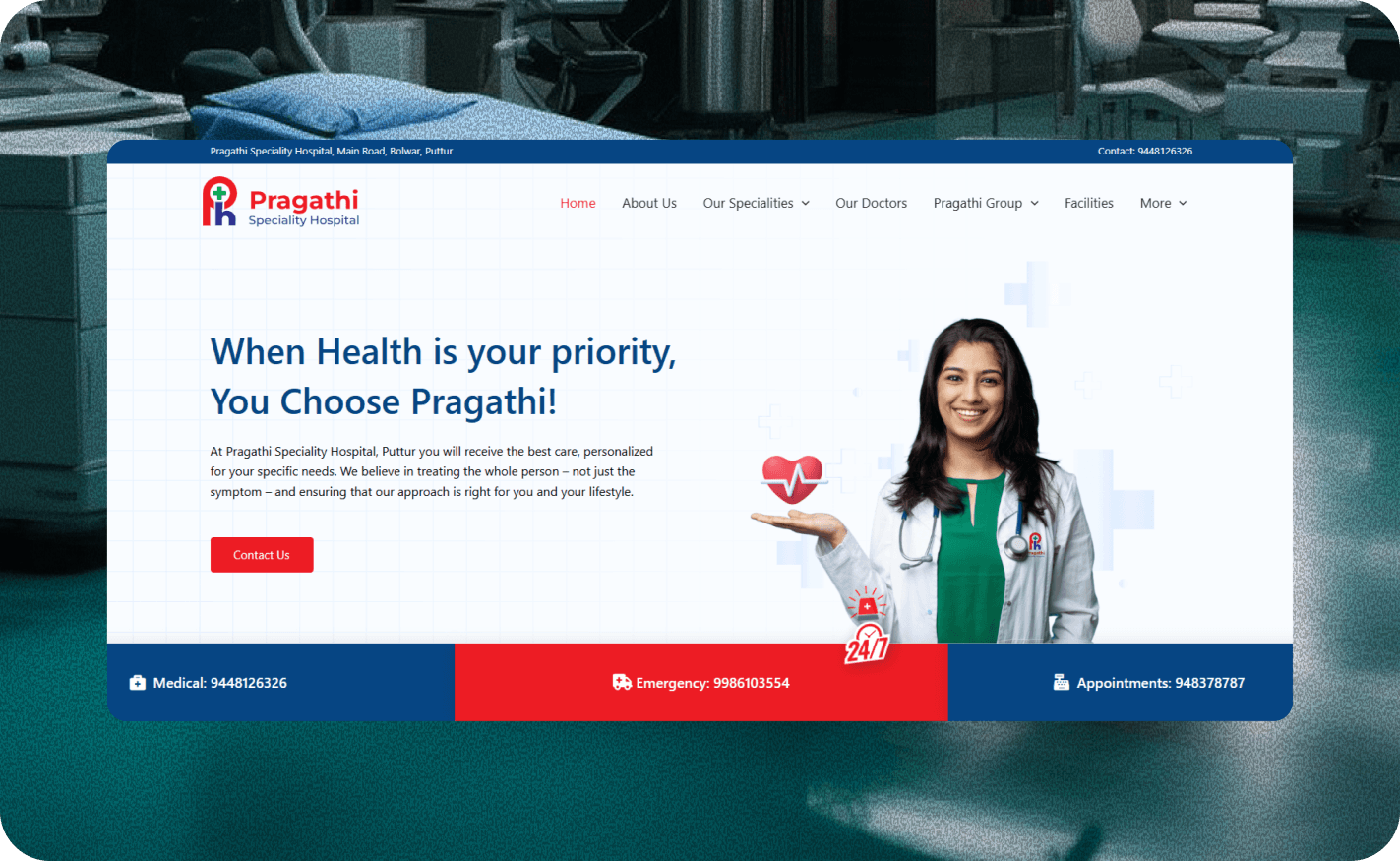
A patient arriving at a hospital website is not browsing. They are looking for something specific under pressure: a department that treats their condition, a doctor with the right specialisation, a contact number for an emergency, or confirmation that the facility has the infrastructure their situation requires. A site that does not answer those questions quickly and in the right sequence does not just frustrate the visitor. In healthcare, it sends them somewhere else at a moment when speed matters.

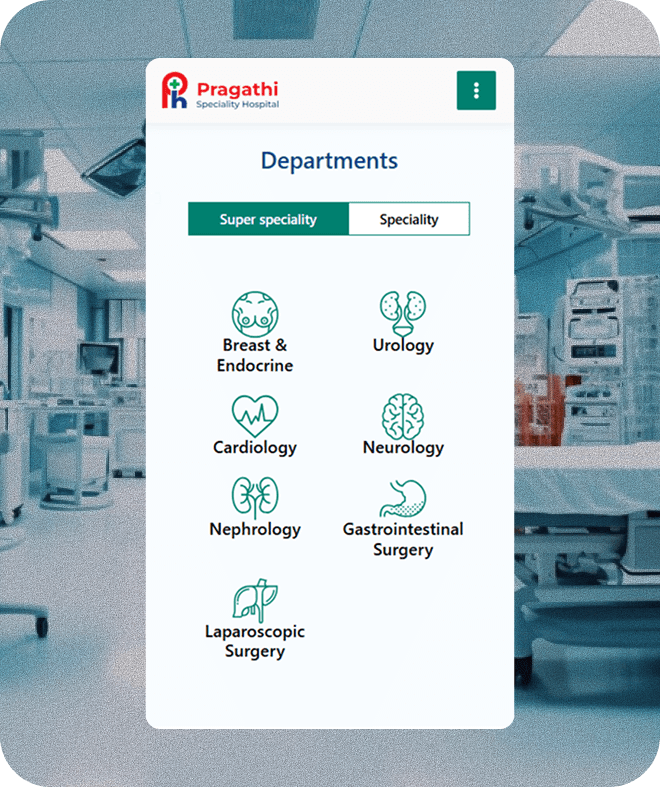
Pragathi Speciality Hospital had been serving patients across Puttur and Dakshina Kannada for 25 years, treating lakhs of patients across a department range that spans General Medicine, Ayurveda, Radiology, Trauma and Orthopedics, Obstetrics and Gynaecology, and Anesthesiology at the speciality level, and Clinical Cardiology, Neurology, Nephrology, Urology, Breast and Endocrine, Gastrointestinal Surgery, and Laparoscopic Surgery at the super speciality level. The institutional depth was there. The facility infrastructure, including ICU, Modular OT, CT Scan, Digital X-Ray, and a fully equipped laboratory, was there. The challenge was that none of it was organized in a way that let a patient find what they needed without working for it.

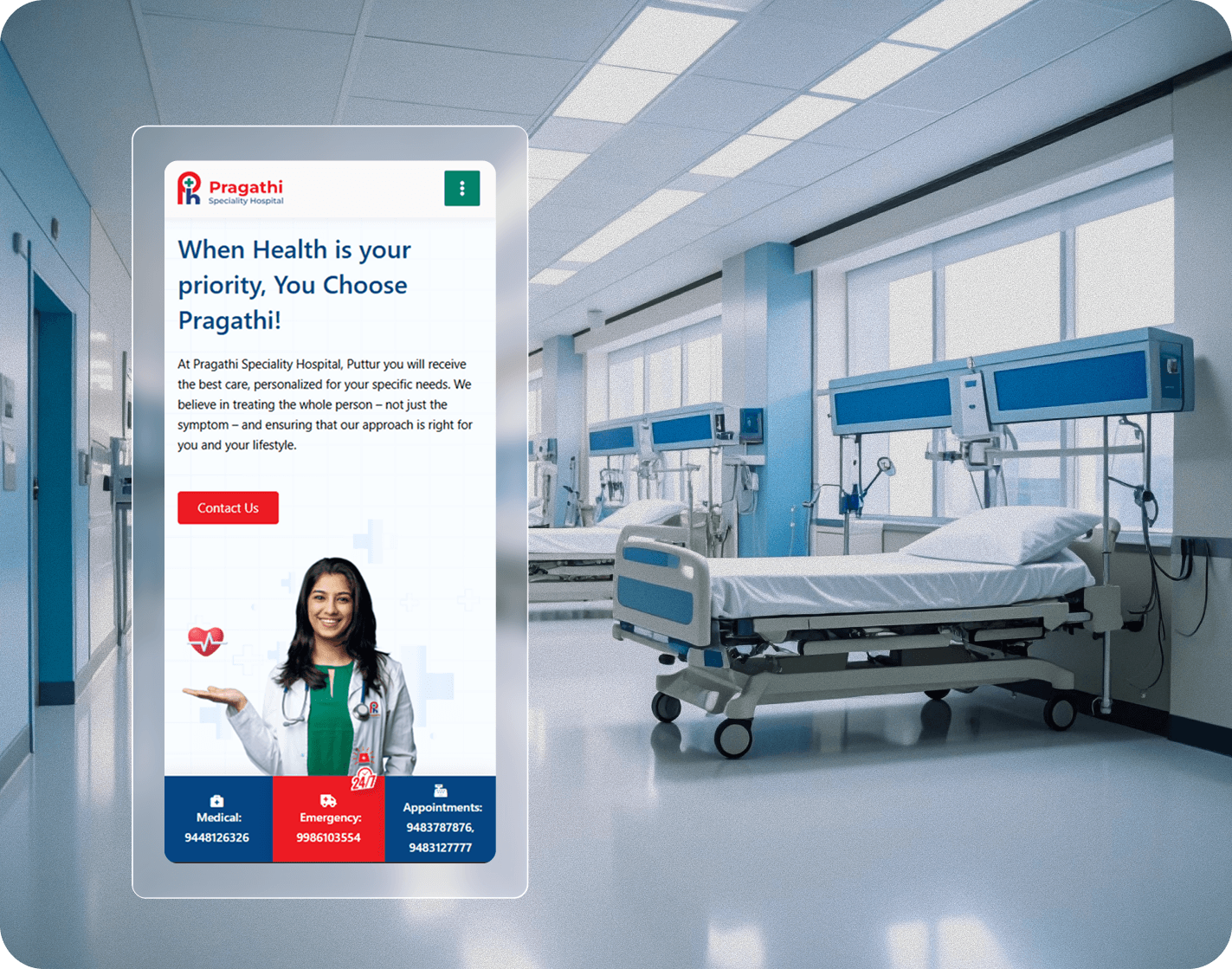
Contact access was a particular structural gap. A hospital with separate numbers for ambulance, emergency, reception, PRO, appointments, and insurance cannot present those as a single generic contact page. A patient calling to book an appointment and a family member looking for an ambulance are in entirely different situations. Both need the right number immediately, not after navigating to a contact page and scanning a list.

Pragathi speciality hospital challenge image 1
Pragathi speciality hospital challenge image 2

Solution

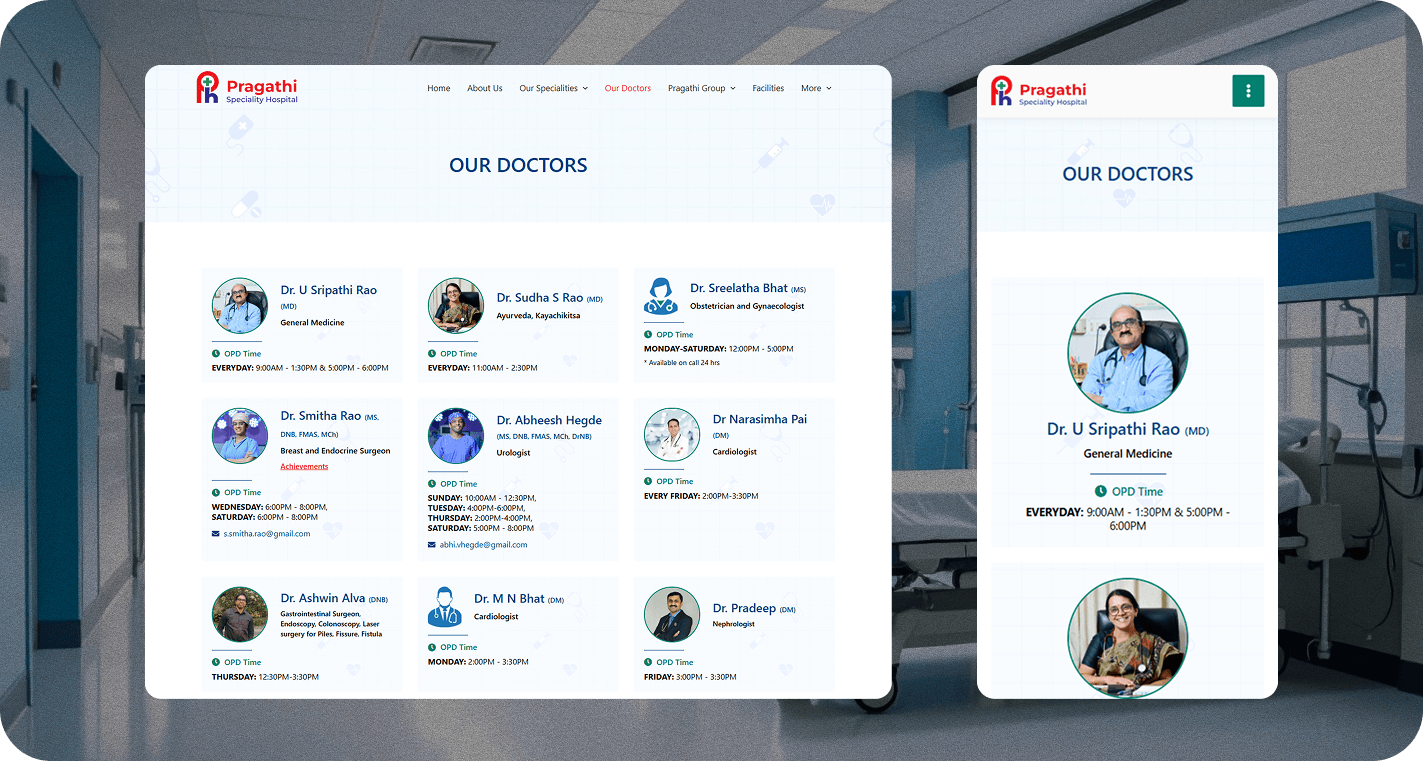
The department architecture was treated as the primary navigation problem. Fourteen departments across two tiers, speciality and super speciality, needed to be organised so that a patient arriving with a specific condition or specialty in mind could locate the relevant department and the doctors within it without moving through content built for a different purpose. Dedicated department pages were built for each speciality, with individual doctor profiles carrying the professional information a patient uses to assess whether to book.

The distinction between speciality and super speciality was maintained structurally in the navigation. A patient seeking general medicine and a patient seeking neurology are not the same visitor, and the site’s department structure reflects that rather than flattening both into a single list. Contact numbers were organised by function and placed with persistent visibility rather than consolidated on a dedicated contact page. The ambulance and emergency numbers sit separately from the appointments and insurance numbers because the urgency and intent of those calls are different. A patient in a non-emergency situation looking to schedule an appointment should not have to parse through emergency contact information to find the right number, and vice versa.

The Arogya Card scheme, which offers 15% reduction in general ward and outpatient bills for Rs. 250 per family, was given a dedicated section. For a hospital serving a community across 25 years, a patient welfare scheme of this kind is a trust signal as much as a service offering. Its visibility on the site communicates the hospital’s approach to accessible care before a patient has read anything else about the institution.

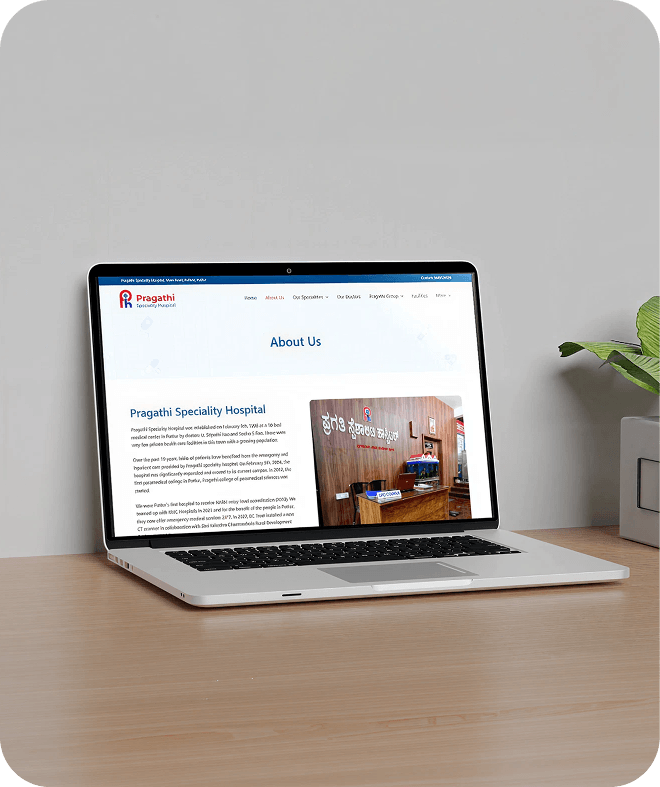
The facility section was built with structured image-led content covering the ICU, Modular OT, CT Scan, Digital X-Ray, and laboratory, so that a patient evaluating whether the hospital has the infrastructure their condition requires can form that judgment from the site rather than calling to ask. The news and events section surfaces the hospital’s broader institutional activity, including updates from Pragathi College of Nursing Sciences and Pragathi Allied Health Sciences, giving the site currency beyond the static facility and department information.
Pragathi speciality hospital solution image

Results of the collaboration so far

A patient arriving at the site looking for a specific department now reaches it through a structured navigation that separates speciality from super speciality and routes each visitor to the relevant clinical area without requiring them to scroll through the full department list. Individual doctor profiles are accessible within each department, so the path from identifying a department to evaluating the doctor within it is contained within a single navigation step.

Contact numbers are organised by function and visible without requiring a dedicated page visit. A patient looking for the appointments line finds it separately from the emergency number. A family member needing an ambulance is not sent to a general contact page.

The Arogya Card scheme is visible within the primary patient journey rather than buried in secondary navigation. A first-time visitor to the site encounters the hospital’s patient welfare commitment as part of the core browsing experience.

Facility infrastructure, including ICU, Modular OT, CT Scan, and Digital X-Ray, is presented with enough visual and structural detail that a patient can assess the hospital’s capability without a phone call. The news and events section keeps the site current with institutional updates across the hospital and its associated colleges.
Pragathi speciality hospital result image

Conclusion

Hospital websites serve patients at moments of genuine urgency, not casual browsing. The work here was to organise 25 years of institutional depth, across 14 departments, multiple contact functions, and a patient welfare scheme, into a structure that answers the questions a patient is actually asking, in the order they are asking them.

Read more case studies

Dwaraka title image
Web Development

Structuring a Multi-Vertical Real Estate Group’s Digital Presence Across Projects, Services, and Community Initiatives

just human title image
Web Development

Engineering a Membership and Dynamic Pricing System on a Platform That Does Not Support It Natively

We work with ambitious brands

Trusted by

Clients
0 +
Popup pattern

Founder Details

Startup Details

Why Fellowship?

Final Check